

“You can dramatically extend life, not by multiplying the number of your years, but by expanding the fullness of your moments.” — Shinzen Young
Is life short or long?
Ask around, and almost everyone says short. The older they get, the more sure they are. Parents especially. “It feels like just yesterday Jimmy was this little.” Or the classic, delivered with a sigh over brunch: “Life is short. You just don’t realize it yet.”
So life is short. Settled.
Except a Roman guy named Seneca called bullshit on this about 2,000 years ago. “It is not that we have a short time to live,” he wrote, “but that we waste a lot of it.” He was roasting rich Romans for chasing extra years while blowing the ones they already had. Some things never change.
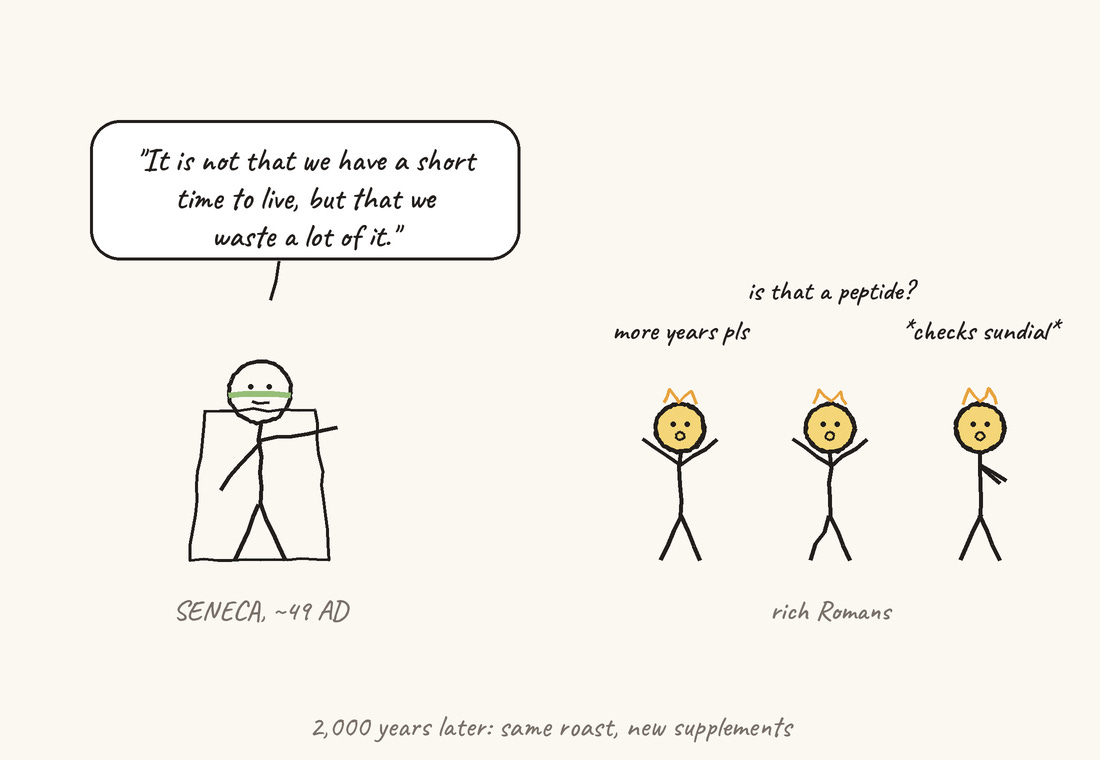
Naturally, we try to stretch life. Supplements, peptides, blood transfusions. Anything for two or five more years with little grandkid Jimmy (who is definitely not already addicted to his iPad). Tech bros where I live are popping more mystery substances than the average character in Euphoria (which I haven’t seen, I promise. Actually I promise).
Live longer, live healthier, live better. That’s the consensus.
Nothing wrong with that (well, mostly). But it skips a question. When you say you want more life, what exactly do you want more of?
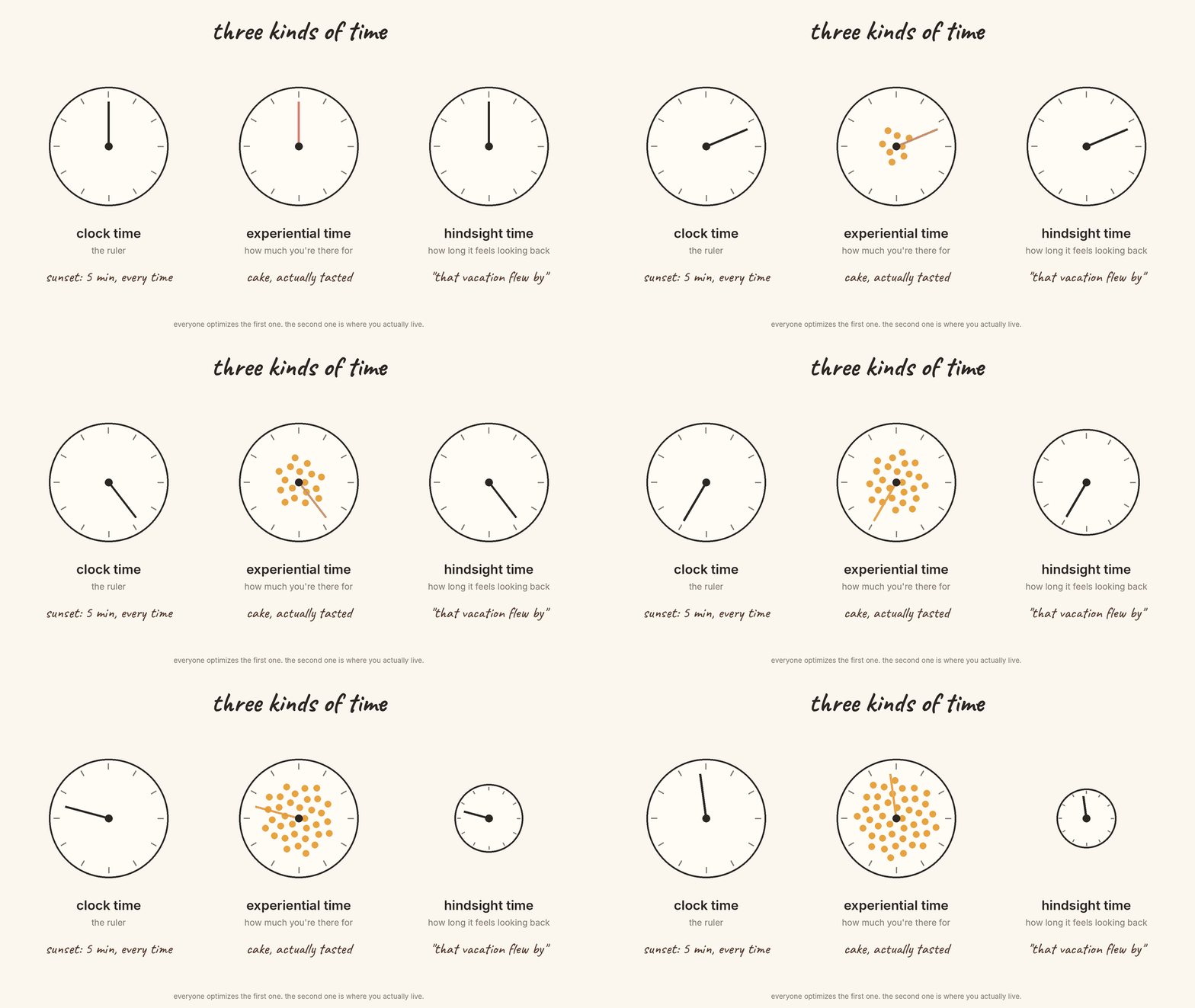
clock time
St. Augustine spent his whole life thinking about this stuff and still admitted: “What then is time? If no one asks me, I know. If I want to explain it to someone who asks, I do not know.” Same, Augustine. Same.
Most of us treat time like a container we all live inside. A minute is a minute for everybody. Sixty years is sixty years for everybody. So, all else equal, eighty beats sixty. Bigger container, more life.
That’s clock time. It’s real. It gets you to your flight. It’s also the least interesting way to think about a life, in my not-so-humble opinion.
hindsight time
Think about the last great vacation you took. On the last night, someone at dinner says the line someone always says: “I can’t believe how fast that flew by!”
Same with the decades. Ask anyone in their fifties: where did the time go? How did the kids get so big? The days are long but the years are short, as Gretchen Rubin put it.
That’s hindsight time. How long something feels looking back.
And we care about hindsight time way more than we admit. Nobody wants to hit eighty and feel like it went by in a blink. If life was good, you want to look back and feel like you lived seven lifetimes in there.
The bad news is that hindsight time is working against you.

I’m 24. Cool. Cool cool cool.
A lot of people took this idea personally. It reads like a horoscope from hell. But the math maths.
When you’re five, one year is a fifth of your entire life. Summer break lasts roughly a geological era. When you’re fifty, one year is a fiftieth. A rounding error. Your brain doesn’t measure a year against the calendar. It measures it against everything you’ve lived so far, so each year feels a little smaller than the last.
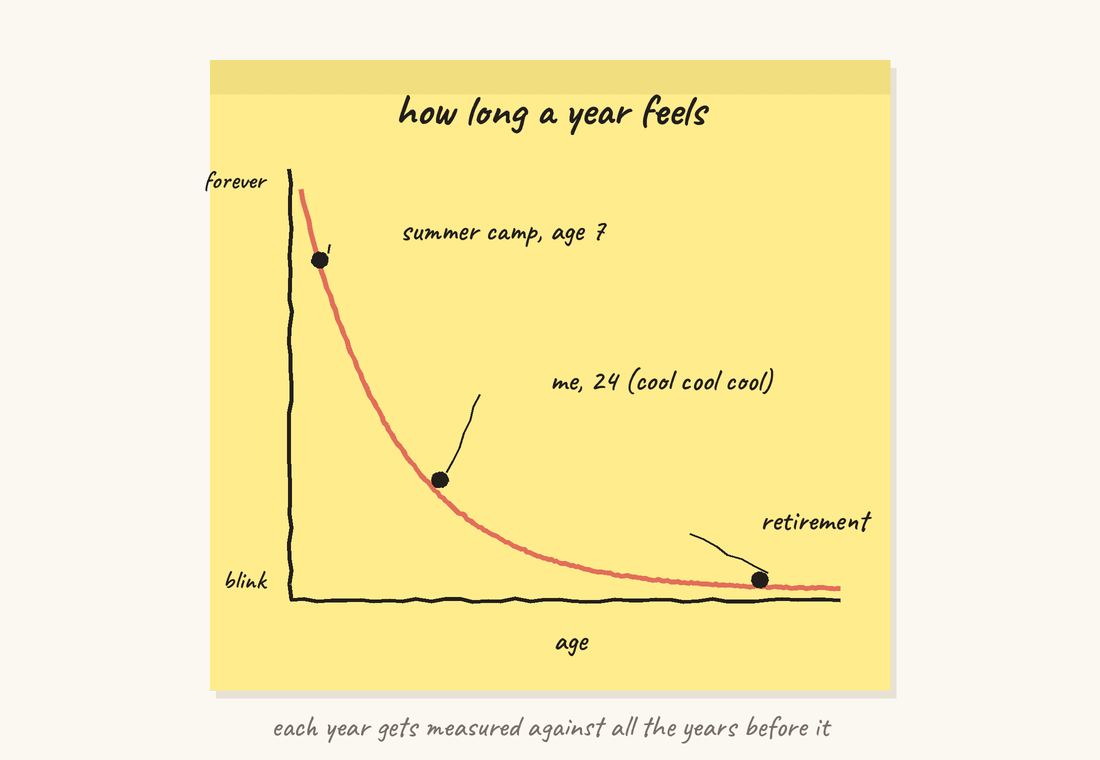
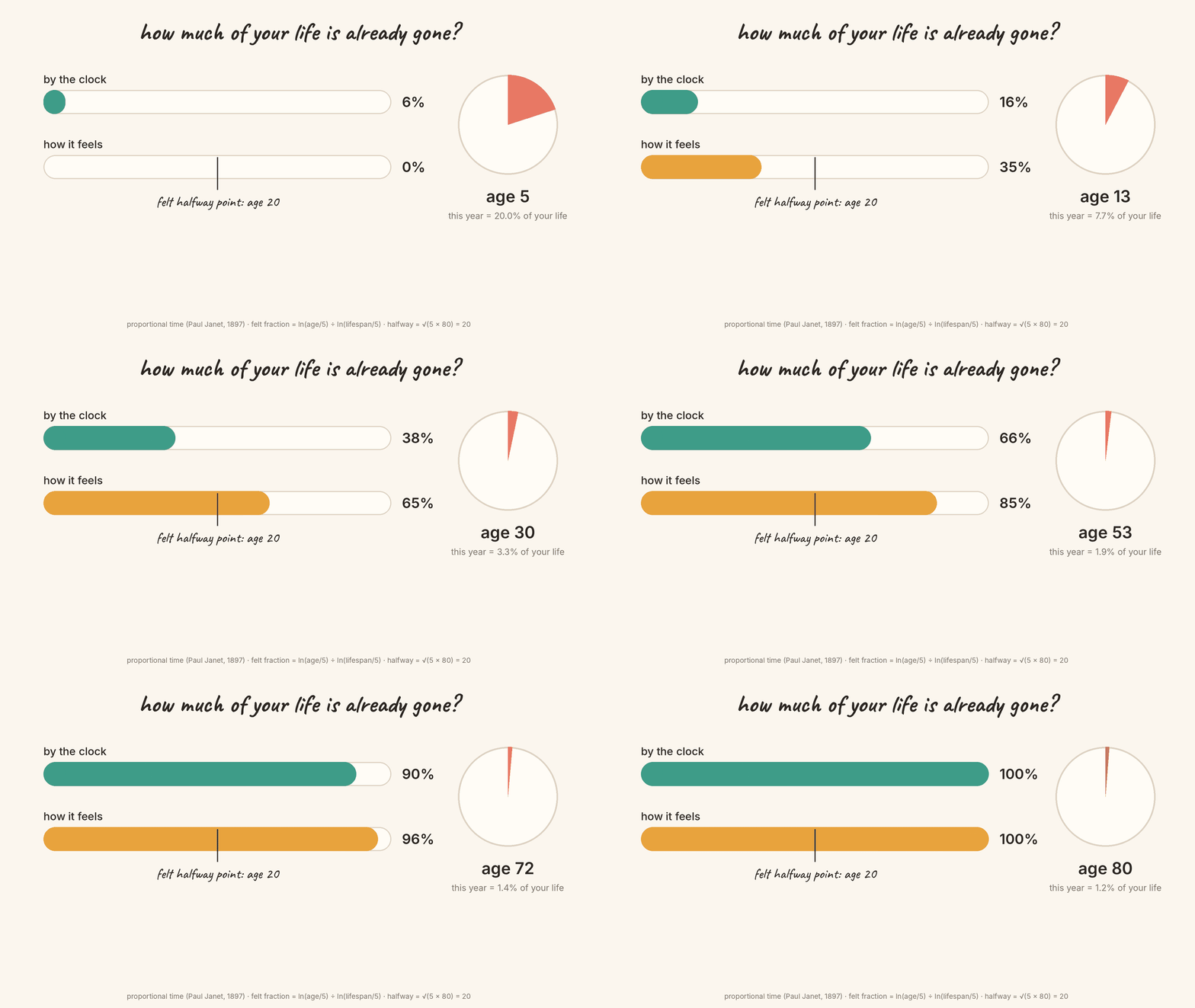
A French philosopher named Paul Janet proposed this in the 1890s, and William James picked it up. Run it through the math (it’s logarithmic, if you want to feel smart at dinner) and your felt halfway point lands around your early 20s. By the clock, you’ve got decades. By the feeling, you might already be past the top of the roller coaster.
The good news: this isn’t gravity. Hindsight time runs on memories. The more distinct ones you lay down, the more there is to measure the past against, and the longer it feels. People who live with seasons tend to feel the year was longer than people in one endless 72-degree loop (RIP LA), because winter, spring, summer, and fall chop the year into chapters. Seven days camping with no phone feels like a month in the rearview. Seven days of the same commute and the same desk salad barely leave a mark.
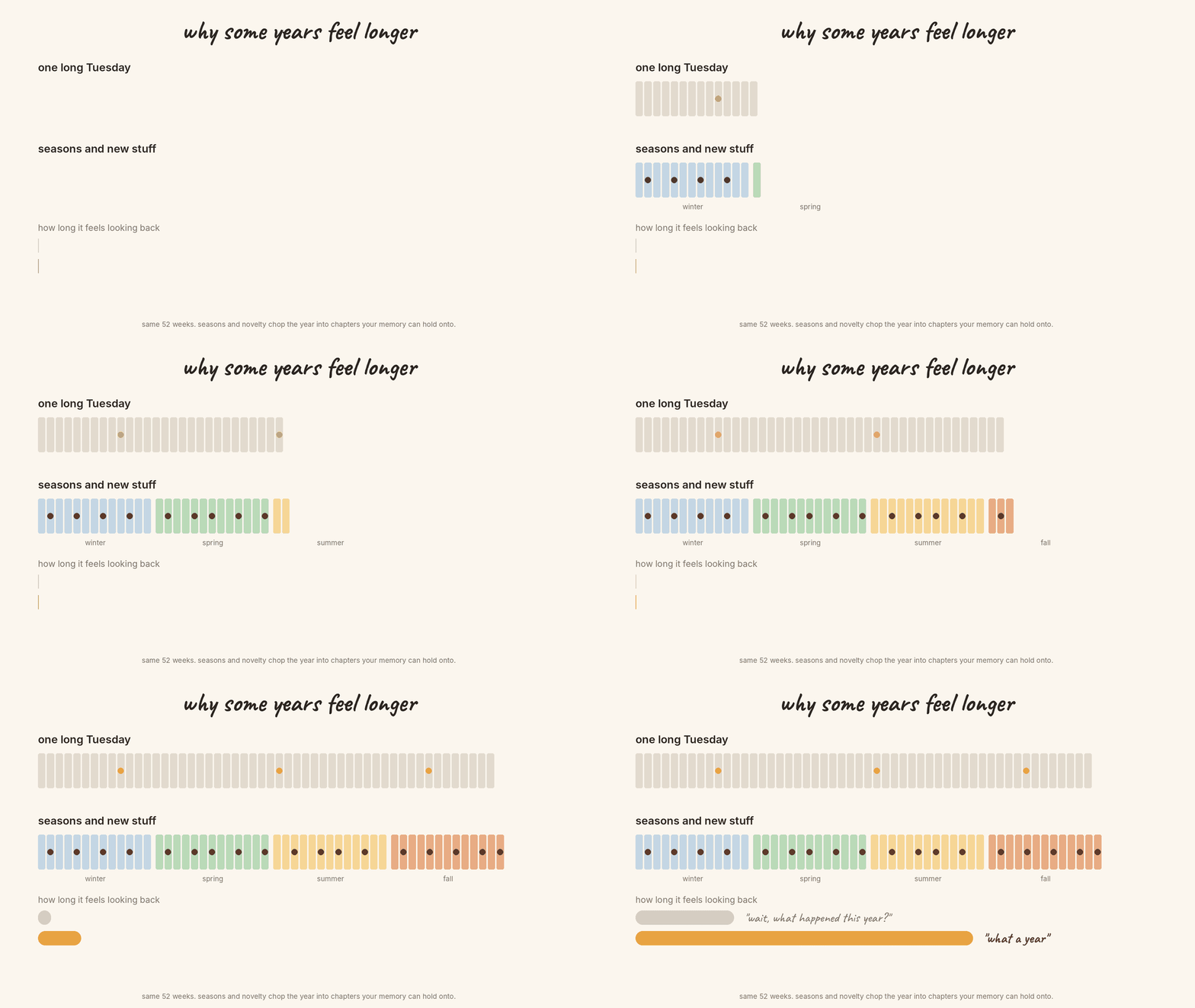
Psychologist Claudia Hammond calls this the holiday paradox. A vacation flies by while you’re on it, then feels long when you look back, because it’s stuffed with new memories.
So: we obsess over adding years, when what most of us actually want is to feel like we lived a long one.
But even that isn’t the whole story. A third kind of time matters more than the other two combined.
experiential time
How do you actually experience time?
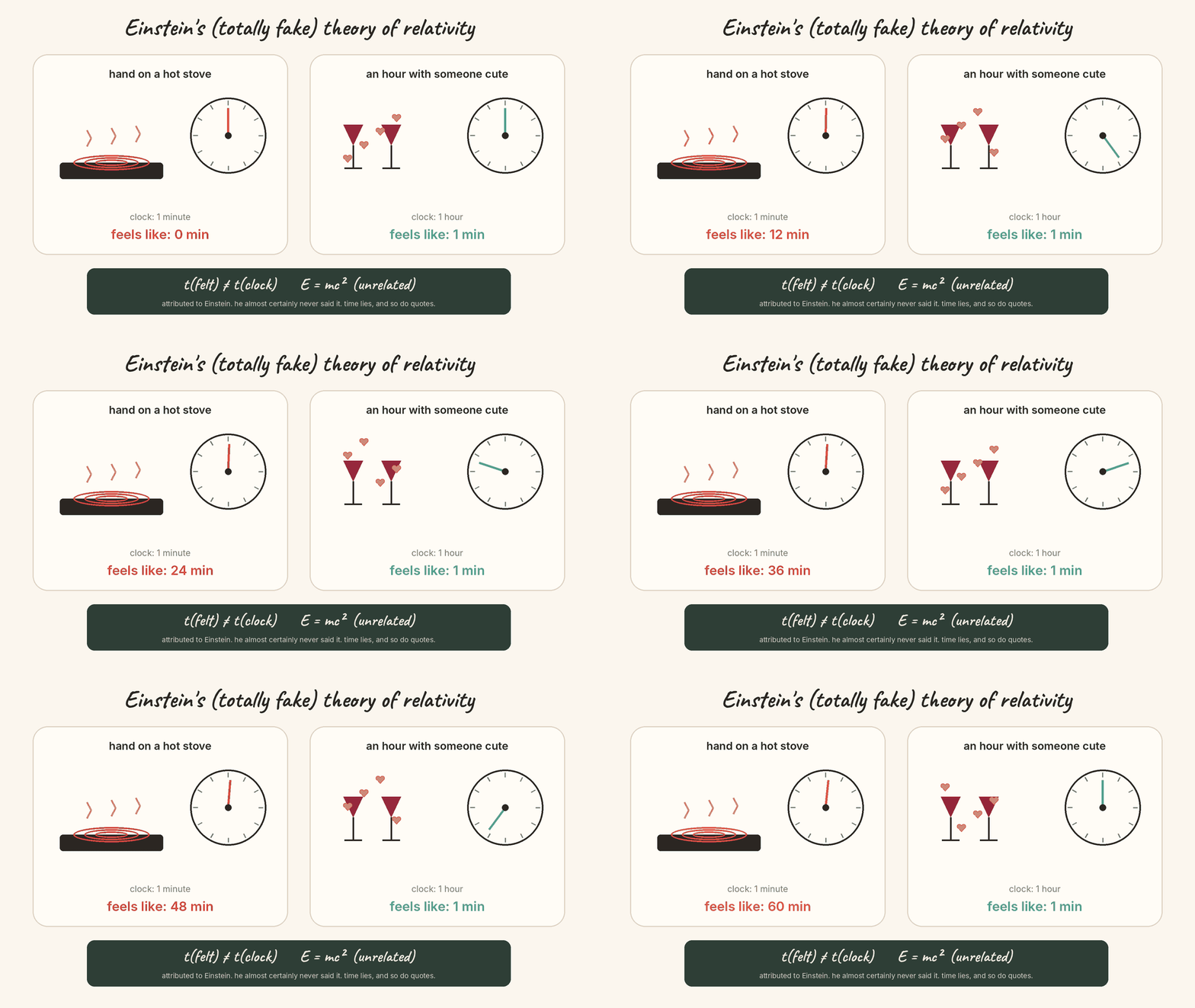
Not as clock time. If you did, sixty seconds would feel identical at a root canal and while making out. Einstein supposedly explained relativity this way: put your hand on a hot stove for a minute and it feels like an hour; sit with a pretty girl for an hour and it feels like a minute. He actually almost certainly never said this, which feels right for an essay about how time lies to you.
What you actually experience is something simpler: how much of the time you’re there for while it’s happening.
To get precise, we need some very old, very nerdy monks.
The Abhidhamma, the Theravada Buddhist map of the mind, says consciousness isn’t one smooth stream. It’s a rapid series of tiny events called mind-moments. Each one arises, knows something (a taste, a sound, a thought), and vanishes. They flicker by so fast that the experience looks continuous, the way 24 still frames a second look like a movie.
So think of your mind as a camera that never stops rolling. Same speed, all day, every day.
The only question is where it’s pointed.
Say I’m eating a slice of dark chocolate cake. (I just found out I have a dairy allergy. SOS. Please send help.)
Round one: I’m actually eating it. The bitterness. The weird little crunch on top. The way the second bite is somehow better than the first. Across the minute, maybe forty seconds’ worth of mind-moments land on the cake.
Round two: same cake, same minute, but I’m replaying a conversation from earlier and drafting an email in my head. Maybe ten seconds land on the cake. The rest are pointed at my own skull.
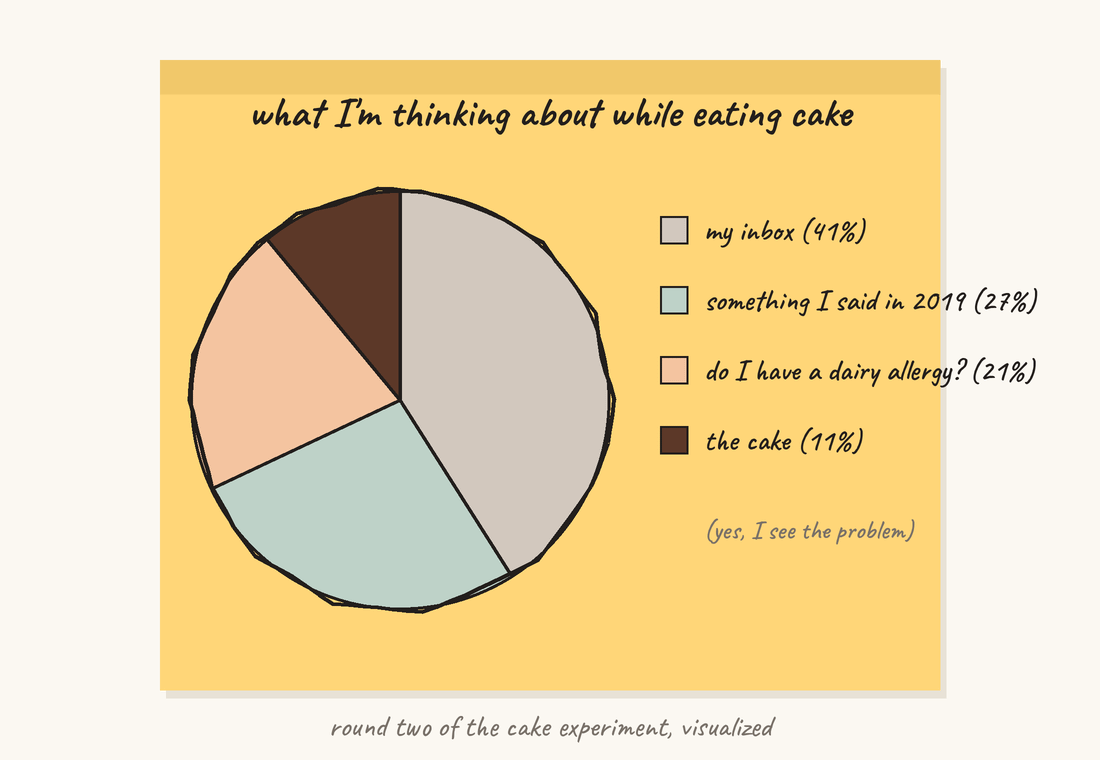
Clock time: one minute, both rounds.
Experiential time: forty seconds of cake versus ten.
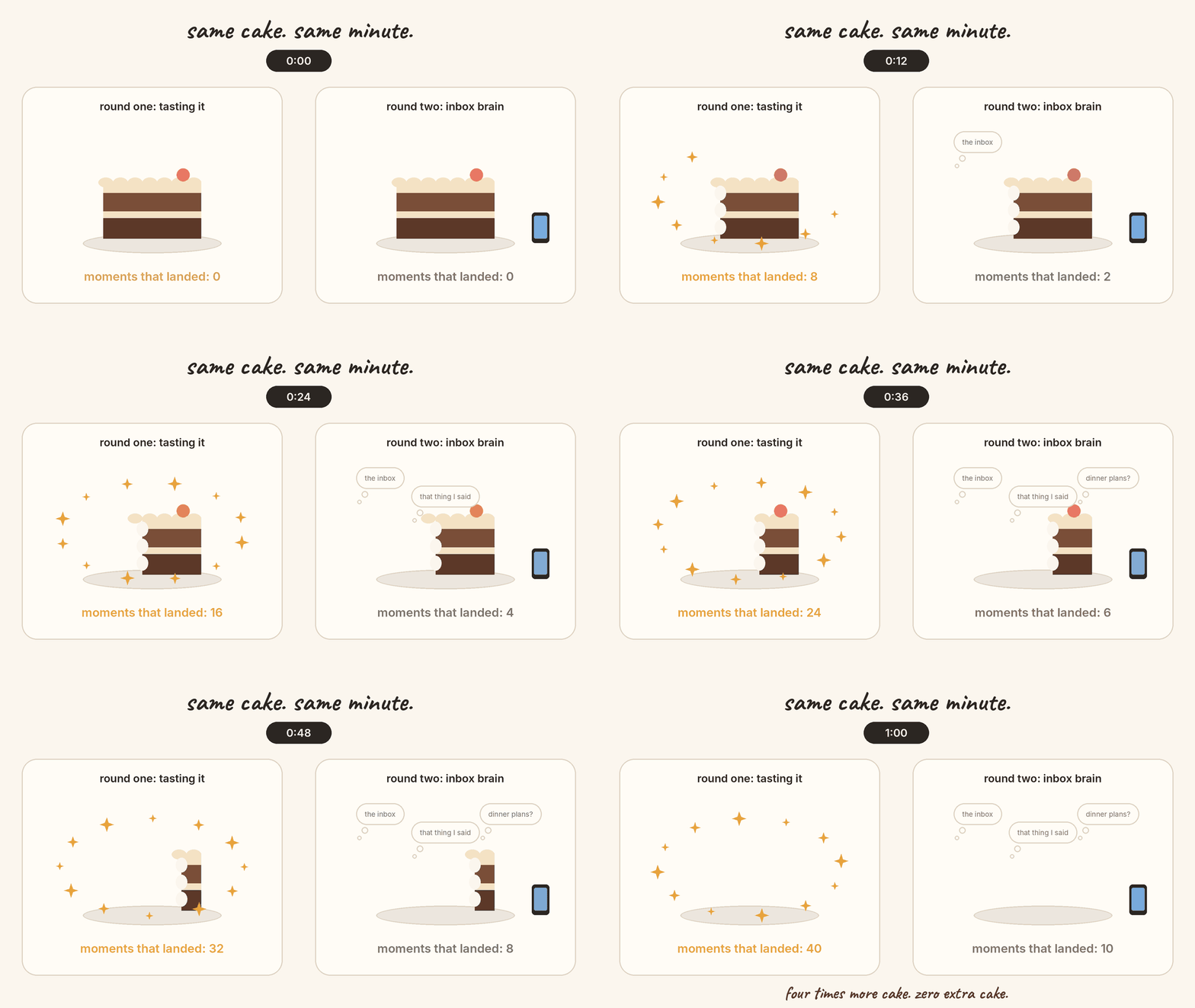
I ate four times more cake in round one, without eating any more cake.
So if one person gets four times more experience out of the same minute, did they live four times more of it? Did they live four times longer?
I think so. And if you’re not ready to go that far, answer this instead: given the choice, which round do you want for the good stuff?
That’s the whole idea right there. Clock time is a measurement. Hindsight is a memory. Experience is the only time you’ve ever actually touched.
why we speed it up anyway
If slowing down experiential time is so great, why does almost everyone do the opposite?
Well, sometimes we want time to fly.
A few months ago I was in the little boy’s room after making the poor decision to eat a milk chocolate lava cake (happens to the best of us). And I did what any reasonable person does: opened Twitter. The minutes vanished. Not because time went faster, but because almost none of my mind-moments were pointed at the misery happening below.
Distraction is anesthesia. And for a lava cake situation, anesthesia can be reasonable.
The problem is we’re almost always under anesthesia. For the good, the bad, and everything in between. We scroll through the root canal, then scroll through the sunset, too. We’ve become so distracted, and so uncomfortable without distraction (like, ahem, just being with our thoughts), that we’re getting less experience out of individual minutes.
Pascal said all of humanity’s problems stem from man’s inability to sit quietly in a room alone. In 2014, researchers at UVA basically tested it. They left people alone with their thoughts for 6 to 15 minutes with one form of entertainment: a button that gave them an electric shock. 67% of men and 25% of women shocked themselves rather than just sit there. (One guy did it 190 times. Honestly, respect)
I recently attended an AI x philosophy lecture (who’s not in SF??), where someone said in a small-group discussion that she “wanted life to feel like it was going by quickly because that meant she’s experiencing more of it”.
I think this logic is exactly backward. The faster life feels like it’s going by, the less of it we are probably experiencing. If we want to live longer (& most people do), we should try slowing down life first.
That doesn’t mean doing fewer things. You can be incredibly busy while also living life slowly. The problem is, most self-described “busy” people are busy laying down memories but always pointing the camera at the next thing, the next activity, the next chocolate cake. They’re not here for this one.
Slowing down life isn’t doing less. It’s giving more of our attention and awareness to the things we’re already doing. It’s being there for more mind-moments.
I have one more hot take before the doc prescribes medicine.
You know how people talk about being in flow? Like, when an athlete is so absorbed in a soccer game that their awareness merges with the field, and they lose track of time and self? Or when you’re eating a delicious, non-dairy, chocolate cheesecake (does this exist? if so pls DM me). Time flies when you’re having fun!
People like flow because the “me” in the back of their head goes silent, for once. You disappear into the task.
But you’ll notice that flow speeds time up, because there are fewer attentive mind-moments. The afternoon is gone, and you weren’t really there for it. Great for creativity. Less great as a philosophy of living.
The end goal is mindful absorption, where you’re fully present and aware for each moment of the soccer game and the cheesecake. And the cheesecake is actually more enjoyable, not less.
how to slow it down
Now picture a camping trip with friends. Everyone’s passing around 90% dark chocolate (fine… it was 83%), the light’s going gold over the trees, and someone’s telling a story that has you crying laughing.
You want this to last forever. And you can make it last longer.
Notice the moments. The snap of the chocolate. Your friend’s face mid-story. The cold creeping in at your back. Then don’t just notice them, live in them. Point the camera at your life instead of at your thoughts about your life.
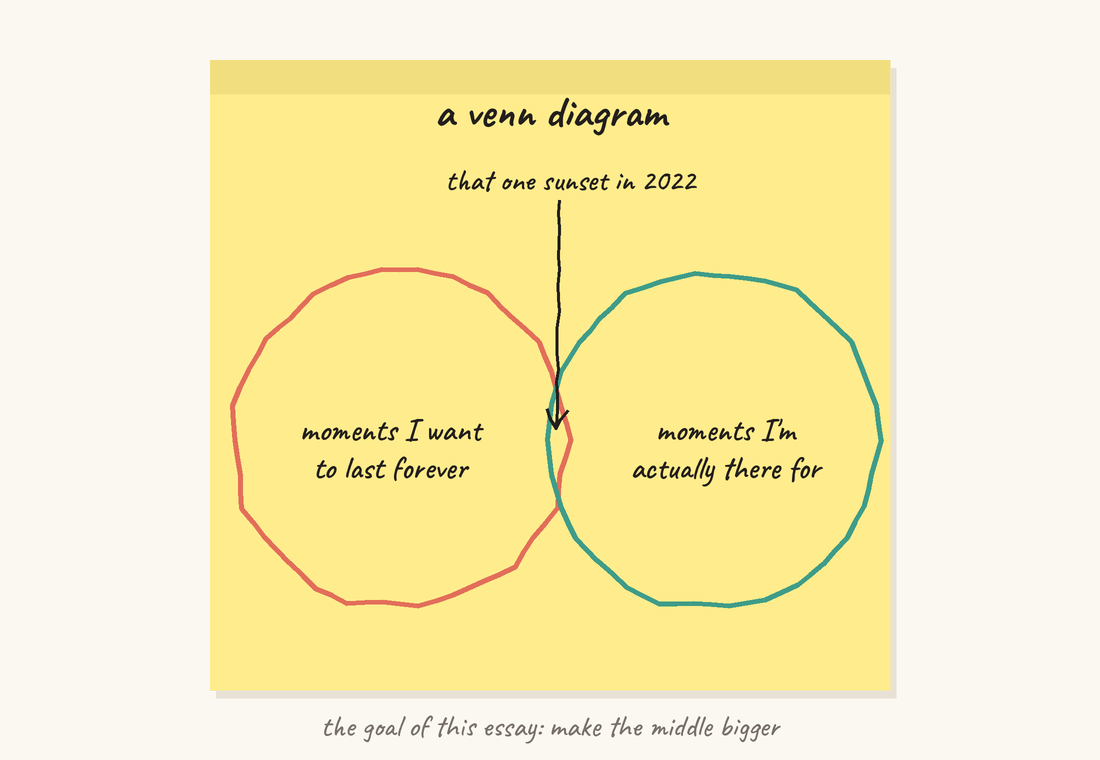
That’s basically what Buddhist concentration practice (samatha) trains: putting your attention on what’s in front of you, and leaving it there. And it’s why experienced meditators so often say life feels slower and roomier. Marc Wittmann studied meditators with about ten years of practice. Their internal clocks were no different from anyone else’s. But they felt less time pressure, more spaciousness, and said the past week and month had felt longer.
Their clocks didn’t change. Their footage did.
Two things to try next time you’re doing something you like:
Count the moments. Not in an Excel way. Just catch them: the sip, the sound, the shift in light. Notice how many you’d normally miss.
Check where the camera’s pointed. How much of you is on the actual thing, and how much is on commentary about it? Nudge it back. Gently. No clenching.
(If you want to go deeper on the Abhidhamma, Bhikkhu Bodhi’s A Comprehensive Manual of Abhidhamma is the standard guide. Fair warning: it’s dense. Also great for insomnia, I’ve heard.)
One trap: trying too hard. If you sit down to “savor this cake mindfully” with gritted teeth, you’ll mostly experience yourself trying. Presence isn’t a clench. It’s closer to noticing what’s already here.
the edges
If all we ever have is experiential time, and life is good enough that we’d want more of it, the logical move is to slow it down as much as humanly possible.
So what happens at the extremes?
Start with DMT. The trip lasts maybe fifteen minutes on the clock, and people come back saying they lived entire lifetimes. Terence McKenna and many others famously meet what they called “self-transforming machine elves.” Researchers at Johns Hopkins surveyed over 2,500 people about their DMT entity encounters, and most ranked them among the most meaningful experiences of their lives.
A friend once told me he lived thousands of years with an alien species and came back to Earth before his Uber Eats arrived.
So did he live thousands of years?
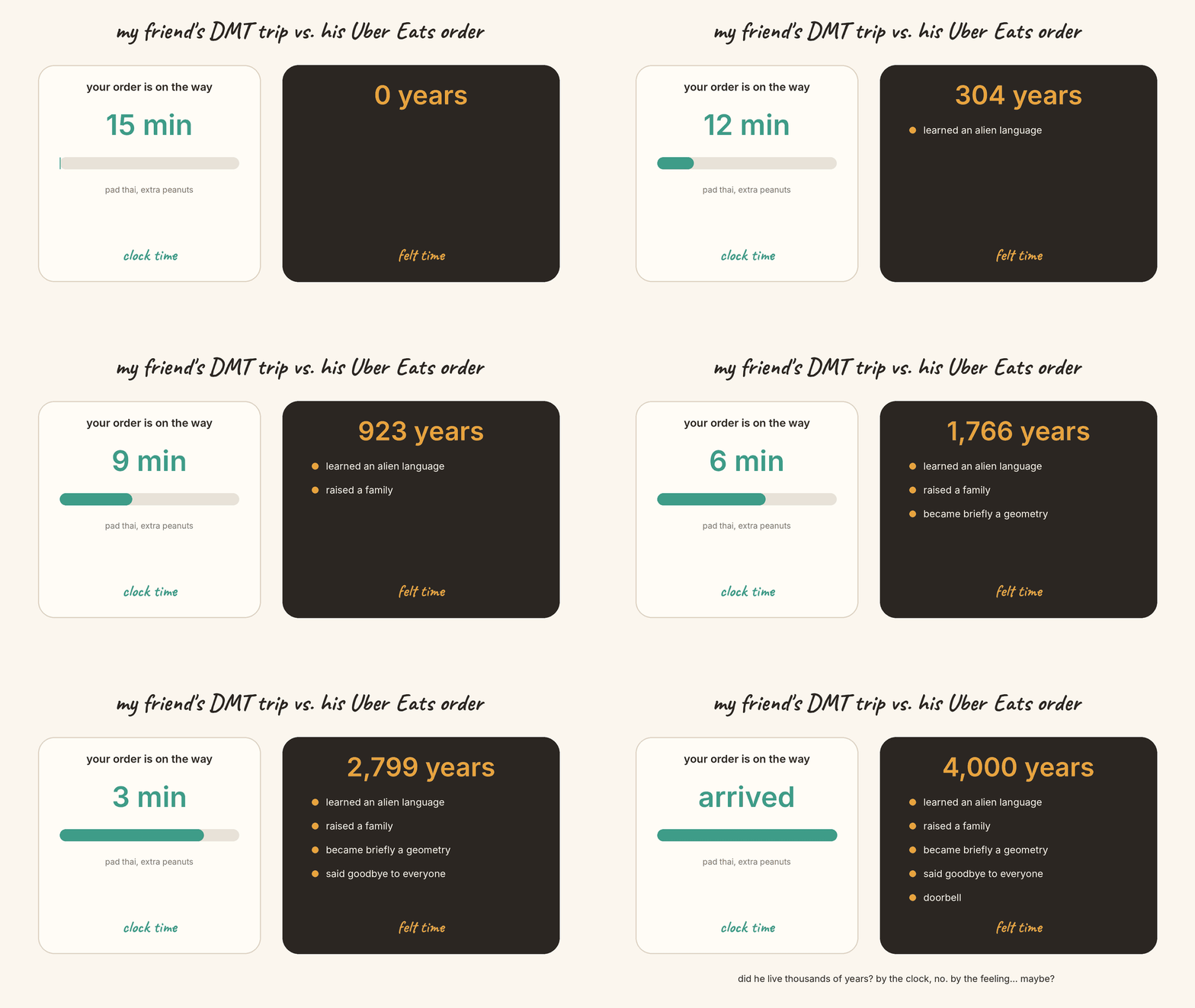
By the clock, obviously not. By the logic of this essay… maybe? If time, as far as you’ll ever personally know it, is your experience of it, then fifteen minutes that felt like a lifetime is at least a weird data point. (Not a longevity protocol. Bryan Johnson, please don’t.)
The meditation path goes somewhere stranger.
Early on, practice is what we’ve been talking about: catching more moments, pointing the camera at your life. But keep going and something fundamentally changes in how you experience reality.
Awareness stops feeling like it’s coming from a little guy behind your eyes. There’s no clear inside or outside. Sounds, sensations, thoughts just happen, and nobody’s there watching them happen.
The camera stops having a place where it’s standing.
And everything feels timeless.
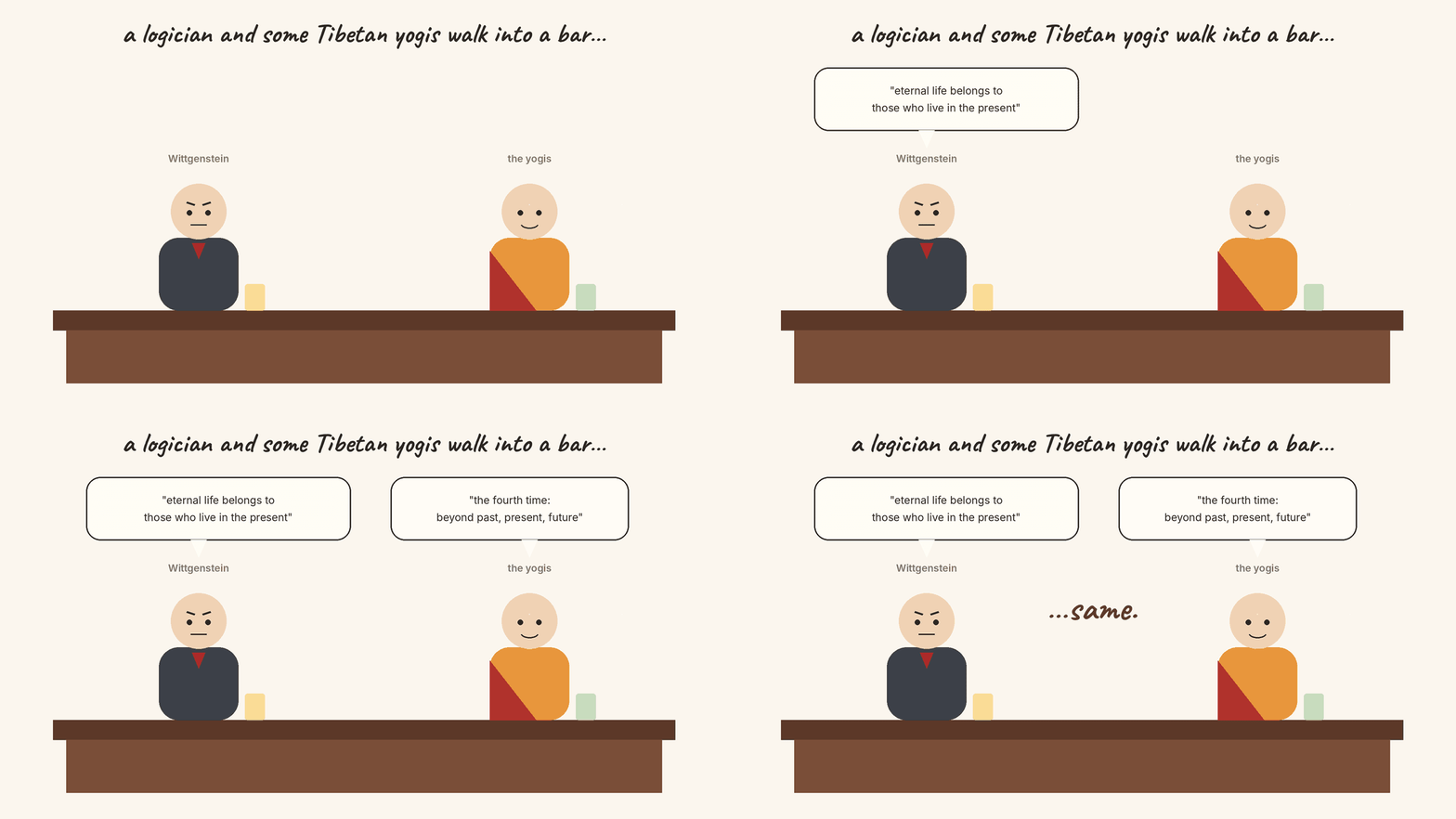
Not infinite. Infinite is still a length of time, just a really long one. This is more like time stops being the right ruler. Eternal, not endless. Dzogchen has a name for it: the “fourth time,” the one beyond past, present, and future.
Wittgenstein, maybe the least woo philosopher who ever lived, landed in the same spot: “If we take eternity to mean not infinite temporal duration but timelessness, then eternal life belongs to those who live in the present.” A logician and a bunch of Tibetan yogis walk into a bar...
Why does it feel timeless? My best guess is that the time we normally feel is built out of a self. A me that remembers what just happened, anticipates what’s next, and keeps checking how long this DMV line is taking. Marc Wittmann wrote a whole book arguing that our sense of self and our sense of time run on the same machinery.
When one dissolves, the other goes with it.
So have you stepped outside of time? Outside the whole deal where things begin and end?
I can tell you this is a real and common experience on the path and that it can become more and more of ordinary life. What it ultimately means is probably a whole other essay.
so, is life short?
I don’t think it’s necessarily short or long.
I know, I know. Easy for me to say. I’m 24. According to Sam Altman, I’m only half done.
But when people say life is short, I don’t think they mean it ran out. I think they mean they weren’t there for it. The camera was pointed at the inbox; the next thing was Tuesday's argument. And you can’t remember footage you never shot.
“Be present” has become such a cliché that nobody knows what it means anymore.
The longevity crowd is working hard on the first number. Hindsight is just the receipt. Almost nobody touches the second number, and it multiplies every year you already have, for free.
We should focus on experiential time. How much time are we actually experiencing, here, right now, in this present moment?
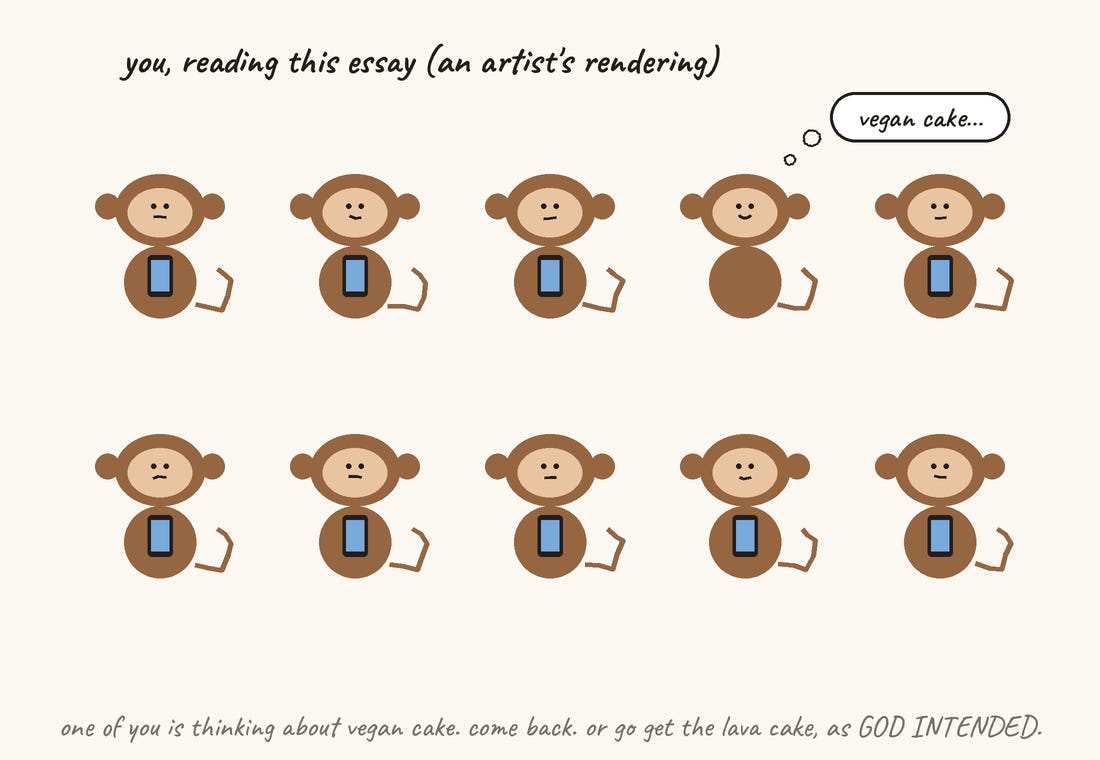
Check in with yourself right now: are you reading this piece, or are you daydreaming about vegan chocolate cake (yuk). Come back to this essay, or get yourself a slice of dairy-riddled, milk-exploding chocolate lava cake, as GOD INTENDED!
“If I was given the choice of living one more day experiencing life the way I experience it, or living 20 more years as a wealthy, healthy, celebrity sexual athlete, beloved by everyone but not experiencing what I experience (vis a vis enlightenment), the decision would be a no-brainer–I’ll take the one day of enlightened living. IT’S THAT GOOD, DUDE.” — Shinzen Young